Sunday 15th June 2014
On Sunday people from Tegal Dowo and Timbrangan communities in Gunem sub-district that are involved in the Network of Communities Concerned for the Kendeng Mountains in Rembang (JMPPK Rembang), received information that there would be an event to place the first stone for a new Semen Indonesia (Indonesia Cement) factory near their villages. From what they heard, this would take place on Monday 16th June. After receiving this news, local people made plans to go to the planned factory site the next day.
Monday 16th June
05.30 : Groups of community members started arriving at the factory site with the idea of staging an action should the laying of the first stone actually take place. As they approached the area, they were blocked by police, who said that they couldn't go ahead with their action because they had not given the police prior notice of their plans. Despite this problem the local people nevertheless carried out their plan, and kept trying to witness the stone-laying event. The police said that information that the event would take place was not true, only that some people would pray together for the construction of the factory to be successful and go smoothly.
06.00 : As they wanted to move towards the factory site, army officers could be seen approaching. Seeing this, the documentation team started recording what was going on.
07.30 : One more military truck was added to block and disperse the action. The people responded by holding their ground on the road near the factory site.
08.30 : Other community members started to arrive and joined those who were already there. The police and army barked their orders once again, instructing people to go back to their homes because their action was not in line with valid procedures.
08.45 : The army and police forcibly dispersed the action. During this incident four members of the 'community documentation team' that were recording the dispersal were arrested by police, who gave the reason that they did not have press cards. They were even accused of being false journalists. They were held in a police car that was parked a short way from the scene. While this was going on one of the 'community documentation team' managed to escape and went on to give information about what had happened to other participants.
09.00 : During the dispersal two women passed out because of being dragged and thrown about by police. The army also kept up the intimidation, saying "people can be punished by law because the action they are taking is improcedural".
09.30-10.30 : There was no longer anyone present who could document what happened as the police tried to disperse the action.
11.00 : Several members of a "new" documentation team started to enter the area, and the atmosphere remained tense. Police and military continued to search anyone they thought might be part of a community documentation team.
14.00 : The police released the community documentation team they had arrested that morning.
14.30 : The atmosphere on the ground was still one of tension and panic . The other women looked after the two demonstrators who had still not regained consciousness.
15.00 ; Having received news that their colleagues had clashed with the army and police, other villagers from Tegal Dowo and Timbrangan villages started arriving to join the action and show their solidarity. However this action was once again blocked by the police and military, who held their position, preventing the newcomers from approaching and joining the others.
18.00 : Villagers from Tegal Dowo and Timbrangan had a plan to send support consisting of food and lighting to those still taking action. However as they tried to bring this to the action site, the army and police forbade them from bringing it in. The team sending the supplies then went back to the village and left themt in the Timbrangan village head's house.
18.30 : Another team from JMPPK Rembang went back to the area and tried to negotiate with the police and military so that the supplies could be allowed inside. However the police and military responded with the sentence "we're still waiting for orders from above". As this happened the women involved in the action chanted and prayed together. The negotiations were tricky, but eventually supplies were allowed to enter and then the action participants were able to set up an awning.
20.30 : Support and solidarity from the people of Rembang started to arrive. This included medical aid.
Afterwards, the community were able to hold the area, constructing a tent so they could rest. Army and Police continued to watch over them until the next day.
Tuesday, 17th June.
07.00-12.00 : The community were holding their ground at the action location, and sticking to their demands that the plans to construct a cement factory are cancelled and the heavy machinery at the factory site is taken away. On this second day of action, police and military continued their guard around the action.
12.00-18.00 : This action has attracted extra sympathy and support from several groups and organisations from outside Rembang. Representatives or individuals from several areas such as Pati, Blora, Semarang and Yogykarta have ben spotted around the action.
20.00-23.00 : The community is still holding on at the action location despite the rainy conditions. Activities such as prayers and reciting the Koran continue.
23.00-24.00 : As they are trying to sleep, several residents are disturbed by screams coming from several police officers that are still keeping guard around the action. They are screaming "there is no cement factory here".
Wednesday 18th June.
07.00-12.00 : The community are still at the action site and are still demanding that plans for the cement factory are cancelled and the heavy machinery in the factory site is taken away. On this third action day, the army and police are still guarding close to the action site.
12.00-14.00 : The rain falls once again, but the community are still managing to hang on.
18.00-20.00 : The community read the Koran and pray together at the action.
20.00-22.00 : The head of Gunem subdistrict visits the action. His/her arrival heralds a acrimonious debate with the action participants.
23.00-24.00 : The community maintain their presence at the action site.
Source: selamatkanbumi http://selamatkanbumi.com/ID/kronologi-aksi-rembang/
Twitter : #saverembang #stopsemenindonesia
Solidarity actions have taken place, or are planned in Semarang, Blora, Palembang and Yogyakarta

Wednesday, June 18, 2014


Repression greets Rembang people's action against cement factory.

Tensions rose at an action by the local people of Rembang to resist a quarry and cement factory today, Monday 16th June 2014. Since the morning, at least three platoons of police, a company of military, and dozens of hired thugs had kept guard over the area where it was planned to lay the first stone of PT Semen Indonesia's proposed plant in Gunem subdistrict, Rendang, Central Java. A water cannon was ready to disperse the demonstrators who were had not agreed to the project, and all access points to the factory site were blocked by state security forces.
This action was a last resort after local people's voices had been gagged for so long, their struggle always met with intimidation, police and hired thugs responding with acts of repression time and time again. In this latest action, mostly by women and farmers, clashes were also unavoidable. Military were also sent in to search family members who were hiding at the road junction leading to the factory.
Several of the mothers involved in the action were injured or fainted, and other residents were also injured. However, the military blocked anyone trying to help the victims and prohibited a waiting ambulance from entering the area.
Four community members who were documenting the events were arrested and accused of being fake journalists,and were held in a police vehicle for several hours. Although they were eventually released, their cameras were confiscated.
It appeared that several journalists from different media organisations had received instructions from the cement company, so they didn't report this action. Meanwhile, friends who wanted to show their solidarity and try to document the action were forbidden to enter the area from the morning on. Searches continued to affect all efforts to document the action, everyone who was involved was made to show a press card.
Guarded by army and police, a truck full of worshippers was seen entering the factory site, said to be representatives of religious scholars affiliated with Nahdlatul Ulama, who were being brought in to say prayers as the first stone was laid. However, Nahdlatul Ulama members strongly criticised this tactic of creating inter-community conflict, as many local Nahdlatul Ulama leaders had already clearly stated their opposition to building a cement factory, as stated in their press release last May.
Until the afternoon, the people continued to occupy the junction leading to the factory site. They also carried out collective prayers whilst tightly encircled by security forces. Their plan was to spend the night in the area and the blockade would continue until their demands were met for all physical work on the factory to stop and the machinery removed from the area.
Let's go to the area and help our brothers and sisters there. Let's report the truth about the repression. Let's spread the demand to cancel all cement quarries in the Kendeng mountains. You can also send text messages to the Central Java Provincial Governor Ganjar Pranowo (+62 811990931) and the Rembang police chief Kurniawan (+62 8131101199)
Let's reaffirm the strength of popular struggles!


[photos from the site taken from twitter @omahkendeng]
LATEST UPDATE (18.51 pm West Indonesia Time, Monday 16th June). A tent belonging to the Rembang people which is still standing near to the factory site is being trashed by police and military officers. Giving the reason that the police chief has given orders, the crowd, which is dominated by mothers, have been forbidden to bring light to the area. Food supplies have also been stopped.
Source Selamatkanbumi.com http://selamatkanbumi.com/ID/aksi-warga-rembang-tolak-pabrik-semen-direpresi-aparat/
Tuesday, January 7, 2014
A Look Back at some Agrarian Conflicts in 2013
A translation of Mongabay-Indonesia's review of some of the clashes over access to land which arose in Indonesia during 2013, based on reports on that website. Of course it only reports a small fraction of the incidents which occurred, but still gives a good overview of the diversity of community struggles for land and livelihood, drawing on news from around the archipelago.
Rosimah was reclining on a wooden bench that afternoon. She was sitting on a covered veranda behind the National Human Rights Commission building, on Jalan Latuharhary, Menteng, Central Jakarta, just a few meters away from the Nabahan Dormitory.
Rosminah spoke haltingly. Sometimes she was silent. “It's hard to think. Too much to think about. I don't know what I want any more.” She spoke slowly. It was clear she was holding back tears. Her lips were trembling. “In the end we came here from Jambi, we want to demand what is rightfully ours.”
Since 10th December 2013, this women in her fifties has been occupying this building along with dozens of other members of the Suku Anak Dalam 113 community. They stay on the veranda, and sleep there at night. An emergency kitchen has been built, protected by a tarpaulin, with a surface to prepare food and cooking utensils. It is a sharp contrast with the luxury buildings that abound in this rich part of the capital.
They are there to demand the return of their customary land which has been claimed by an oil palm company, PT Asiatic Persada. They are also demanding that this company's land use permit (HGU) is revoked.
Rosimah lived in Pinang Tinggi village, Batanghari, Jambi. Her home and garden are considered to be part of the company's concession. “It's all gone, our two houses pulled down. Rubber trees, durian trees, rambutan, cempedak, the company destroyed them all.”
Yet, she says, her ancestors have always lived there. “This was the land of my grandmother, I was born there, I have six children, they're all grown up now, lots of grandchildren were living there. And now it's all gone...”
 |
| Rosimah, taking part in the Action. Since December 10th she has camped out on the National Human Rights Commission back veranda. Photo: Andreas Harsono |
Rosminah spoke haltingly. Sometimes she was silent. “It's hard to think. Too much to think about. I don't know what I want any more.” She spoke slowly. It was clear she was holding back tears. Her lips were trembling. “In the end we came here from Jambi, we want to demand what is rightfully ours.”
Since 10th December 2013, this women in her fifties has been occupying this building along with dozens of other members of the Suku Anak Dalam 113 community. They stay on the veranda, and sleep there at night. An emergency kitchen has been built, protected by a tarpaulin, with a surface to prepare food and cooking utensils. It is a sharp contrast with the luxury buildings that abound in this rich part of the capital.
They are there to demand the return of their customary land which has been claimed by an oil palm company, PT Asiatic Persada. They are also demanding that this company's land use permit (HGU) is revoked.
Rosimah lived in Pinang Tinggi village, Batanghari, Jambi. Her home and garden are considered to be part of the company's concession. “It's all gone, our two houses pulled down. Rubber trees, durian trees, rambutan, cempedak, the company destroyed them all.”
Yet, she says, her ancestors have always lived there. “This was the land of my grandmother, I was born there, I have six children, they're all grown up now, lots of grandchildren were living there. And now it's all gone...”
Saturday, December 28, 2013
David Versus Goliath in the Aru Islands
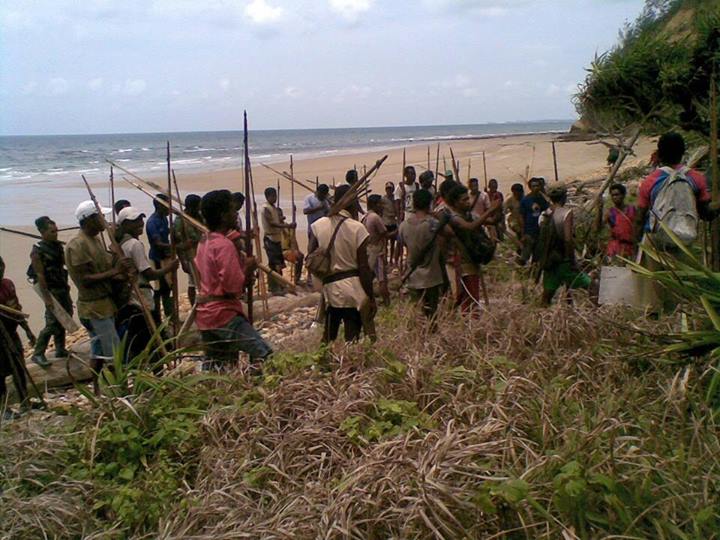 In December 2013, PT Menara Group is meant to start operations in Aru. That’s according to the Menara Group’s work schedule which has become general knowledge amongst government officials in Maluku Province and Aru Regency, especially Maluku’s caretaker governor Saut Situmorang.
 How can that have come about? The officials claim that all the permits are issued according to procedure, there are no problems with the environmental impact assessment, and the people of Aru raise no objections. If there are some people who object, it is only a handful of people, who are not the customary landowners. Can this all be true?
The call to Save Aru has become a global movement. School and university students, academics, researchers, NGO activists, nature lovers, journalists, artists, religious teachers, all sorts of groups from across five continents have echoed the cry to Save Aru. Petitions have taken off, songs have been sung, performances staged, poetry inspired. The fire of resistance continues to grow.
The giant consorsium PT Menara Group plans to develop sugar-cane plantations in the Land of Aru, the land called Jargaria. It has ambitions to take control of around 500 thousand hectares for this purpose. Before planting this vast plantation and building a sugar factory, first of all it would clear-fell the forest, full of top-quality timber such as meranti, linggua, ironwood and so on. This would inevitably be an ecological disaster, as birds of paradise and other wildlife endemic to Aru are cleared from their natural habitat. This is the Menara Group’s plan which is meeting vehement challenges from the Save Aru movement around the world.
Thursday, December 19, 2013
Open letter from the Suku Anak Dalam in Jambi Province
To all palm oil consumers around the world, stop draining our tears and our blood!!!
“Some thoughts about the evictions of our homes by PT Asiatic Persada in Jambi Province.”
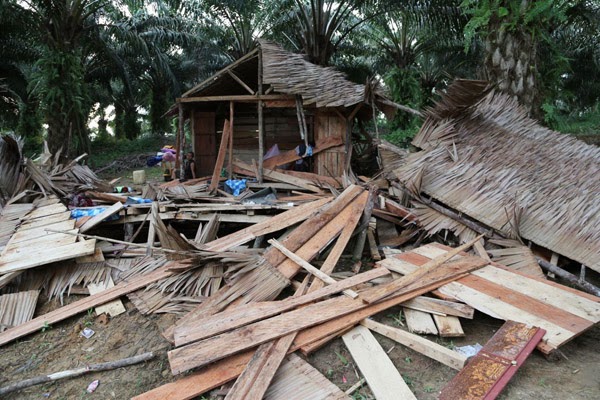
“Hundreds of people appeared suddenly, they were wearing police or police mobile brigade uniforms, along with others wearing the clothes of PT Asiatic Persada employees. We were shocked and scared, as we realised they had come to destroy our houses. We could only stand by and watch as our homes were demolished by the company's heavy machinery, and we also had to just accept it when they took away some of our possessions.” That is how one of the evicted Suku Anak Dalam described what happened, when we visited them on 11th December 2013 at 17.00.
PT Asiatic Persada has taken action once again, just as it did in 2011, when it also managed to smash up around 80 houses in the Sungai Beruang area. This time, PT Asiatic Persada and state security forces carried out an intense wave of evictions between 7th-11th December around Pinang Tinggi, Padang Salak, Tanah Menang and Terawang. Currently around 146 houses have been razed to the ground, and those 146 families have sought refuge in Jambi City.
Monday, December 2, 2013
Conflict Between Takalar Farmers and PTPN XIV Flares up - Farmer Shot by Police
The conflict between residents of Takalar Regency, South Sulawesi and state-owned plantation company PTPN XIV has flared up once again.
Unavoidable clashes between the people of North Polongbangkeng Sub-district and Police Mobile Brigade (Brimob) on Monday morning (2/12/13) resulted in community member Yunus Daeng Empo receiving a bullet in his right thigh.
When contacted by Mongabay, Zulkarnain, Walhi South Sulawesi's executive director, said that the incident was provoked by PTPN IV's plan to cultivate disputed land which is the subject of an ongoing case in the Supreme Court.
On hearing about this plan, dozens of local people went to the location being guarded by 10-20 members of South Sulawesi Police Mobile Brigade. The situation heated up as PTPN XIV failed to heed the community's protests. Yunus Daeng Empo was trying to stop the company working the land when the police shot him. “The situation became chaotic when Brimob started arresting and shooting people,” Zulkarnain said today.
Friday, November 1, 2013
A Growing Movement Against Plantations in West Papua

“We, the indigenous people of Yowied Village reject corporations coming on to our land in Tubang District for the following reasons:
there is not so much land around Yowied Village.
Our lives are dependent on what our environment can provide.
Where will the future generations go?”
For now, the natural ecosystem in remote Tubang District is still in good condition, and the Malind Woyu Maklew people who live in the area can easily find all they need from the forest by hunting, gathering and fishing. The former chief of Yowied village has claimed that he could easily live on only $2 a month, which he would use to buy tobacco and betel nut – everything else could be got from the forest.
Throughout Merauke Regency in the southern part of West Papua, a land controversially annexed by Indonesia 50 years ago, indigenous communities are having to learn fast how to resist corporate manipulations. In 2009 ambitious local politicians proposed Merauke as Indonesia’s new centre for industrialised agricultural growth. This was in the aftermath of the 2008 global food crisis, when governments worldwide got preoccupied about national food security, prompting a wave of land-grabbing globally. The Merauke Integrated Food and Energy Estate (MIFEE), as it became known, was officially launched three years ago in August 2010. Around 50 provisional permits have been issued to around 20 corporate groups, mostly from Indonesia or South Korea.
'Jogja Not for Sale': not just looking for Haryadi

Actually, this action was happening for the second - or third - time. The mural had first been painted on the actual anniversary of Jogjakarta, two days previously on the 7th October. However, before twenty-four hours had passed, the slogan “Jogja Ora Didol” had already disappeared, painted over by black paint, apparently by the municipal guards. Then the same phrase was painted over the black paint as a response. However Arif's action ran into trouble when a middle-aged man forced him to stop what he was doing. The man ordered Arif to come down from the wall he was standing on, but Arif didn't move. In the end Arif gave in as the man was pointing a pistol at him. Arif was brought by the man to the municipal guard's barracks to be interrogated and file an evidence report.
What Arif was actually doing - in theory - was part of the urban movement 'Looking for Haryiadi Festival', which had been conceived by various artists and collectives around Yogyakarta city. The Festival's Art Director, Agung Kurniawan, said that this movement had been sparked by concerns that city mayor Haryadi had absented himself from the task of reorganising public space, controlling visual pollution such as billboards, and other urban problems. There are also massive plans to build hotels, which mean evictions, and the uncontrolled growth in motor vehicles which causes traffic jams and increasingly takes space away from cyclists and pedestrians. As all these problems pile up around him, Haryadi has just chosen to travel abroad - the mayor's latest travels have taken him to Spain and the United States, who knows what for. In the end, it means thatYogyakarta is starting to become a less pleasant place to live.
But is it right to direct all the criticism only at Haryadi? Or is there also someone else involved who should also be facing accusations? I want to open up this possibility, that Haryadi is not the only one who should take the blame for the chaos in Yogyakarta's urban planning. Of course, if we see Haryadi as the administrative head of Yogyakarta City, he's the one who must be asked to take responsibility for any chaos in urban planning. He is also believed to be allowing visual pollution - such as corporate advertisements - affect buildings in a cultural conservation area. But actually, similar cases are not only happening in Yogyakarta City, but also other places around Yogyakarta Province. In Bantul for example, traders in Parangkusumo are threatened with eviction by a megatourism project which plans to develop the Parangtritis area. In Kulon Progo, coastal farmers are on the point of losing their farmland because of plans to develop an iron-sand mine. Hotel and other tourist development is also taking place in Sleman and Gunung Kidul districts.
Thursday, October 3, 2013
Kulon Progo Farmer Tukijo Freed From Prison
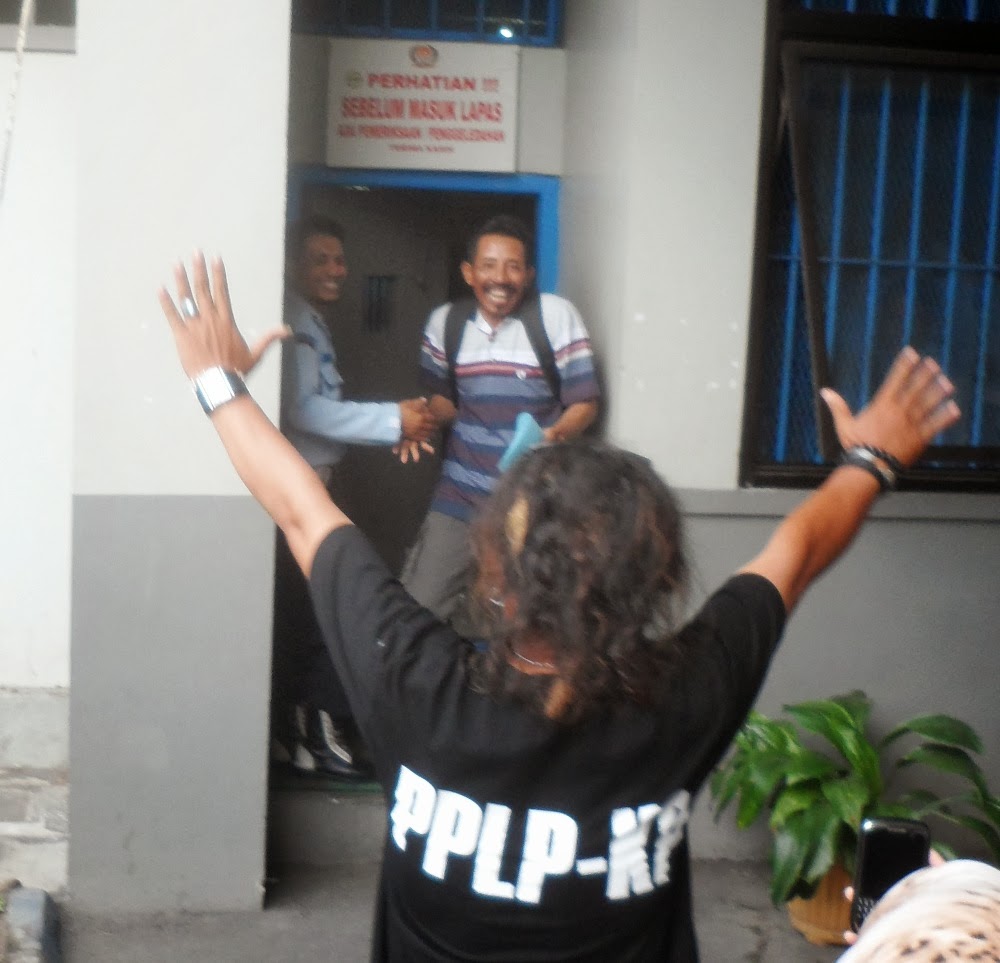
Tukijo is one of the thousands of farmers along the Kulon Progo coast who are defending their land from an Australian mining company in partnership with the local feudal leader. He was snatched from his fields by police in May 2011 and sentenced to three years in prison for doing nothing more than telling a company worker to get off the land.
After nearly two and a half years in prison, Tukijo will now be able to return to his farm to plant chillis and watermelons once again, as the land has not yet been taken over by Indomines for its iron sand mine. Whether due to it's tumbling share price, a fall in demand for iron from China or the farmers' determined resistance, the mining company's plans have been put back again and again.
But the mining threat has not gone away. Worryingly, news has come through within the last few weeks that some villagers at the far end of the mining area have accepted a downpayment from the company, agreeing they would sell their land. This came as a big shock to other villages, which have been more centrally involved in resisting the mine. They believe they are more determined in their struggle, but now they can see how easy it is for a company to manipulate any weakness.
Although the Kulon Progo farmers have lived on the land for generations and developed their own techniques to make the sandy dunes fertile and productive, they are up against the local feudal leaders (Sultan Hamengkubuwono X and Paku Alam), who are claiming ultimate ownership over all land in the Yogyakarta Special Region province where no freehold has been granted. It is a dubious claim dating back to colonial times, which was clearly outlawed by Indonesia's Basic Agrarian Law in 1960. However the Sultan has been trying to strengthen his legal position by lobbying for new laws. A national law on Yogyakarta's 'specialness' was passed last year, and next week the Yogyakarta Provincial Legislative Council is expected to pass a local law which supports the feudal system.
Around the Yogyakarta Region, many people are not yet aware that their Sultan has got his eye on their land - maybe they are proud to live in an area where the Javanese culture is still strong, or they see the system as better than the rampant corruption which causes so many problems in other areas. However, several communities are aware and are resisting. Aside from the Kulon Progo farmers, the community of Parangkusumo is one example. This coastal village is a few kilometres away from the popular tourist beach at Parangtritis, and is facing eviction. The reason given is a moralistic one - the local government claims prostitution goes on in the karaoke bars there, but it is fairly obvious that the real reason is to clear the coast for tourism development.
So while it's good news for the moment as Tukijo celebrates being able to breathe once more the fresh sea air blowing in over the Kulon Progo coast, there are still many challenges ahead before the Kulon Progo farmers can finally relax, knowing they have defeated the iron mine once and for all.
Thursday, September 5, 2013
16 Medan Students on Trial
Latest developments in the arrested Medan students' case
The following is an interview by an FKMA reporter with a student from Medan, conducted on the 1st of September 2013 in Jakarta. The aim of the interview was to find out the latest developments in a case where police arrested students in an action protesting the fuel price rise in Medan last June, in a clear violation of human rights.
FKMA : What are the latest developments around these arrests which have affected Medan's student community?
Student : There are currently 16 students still in prison who were officially declared suspects on 16th August 2013. Many of them are still suffering from broken bones from the police violence during their arrests.
FKMA : Originally how many people were arrested?
Student : On the day of the action there were 87 people arrested. In the end only 16 of them were officially declared suspects. Nevertheless this is an act of criminalisation towards the whole student movement, and we are convinced it is an attempt to systematically paralyse the student movement here in Medan.
Monday, August 19, 2013
West Papua Freedom Flotilla: Indigenous Solidarity Knows no Borders

The indigenous movement in Australia has not disappeared however, and is aware that on the other side of the Torres Strait, their history is being replayed in West Papua. Indigenous Papuans are also being economically and culturally marginalised, their forests and mountains ravaged, set against a background of half a century of military violence.
The Freedom Flotilla to West Papua is an initiative of indigenous and white Australians, Torres Straits Islanders and West Papuan refugees, who are trying to make the link between the struggles on their respective islands. On 17th August they launched two boats from Cairns, headed for Merauke in West Papua.
Friday, July 5, 2013
Demonstrators Against Fuel Price Rise in Medan Arrested and Tortured: Chronology
As the Indonesian Government made plans to reduce fuel subsidies, social resistance broke out across the archipelago, protesters fearing that the price rise would cause knock-on rises in the cost of living that would have a devastating effect on the poorest. The government has wanted to make this spending cut for several years now, but popular resistance over the years has made it very difficult to push it through. This time, however, they seem determined. One action in Medan, North Sumatra on the day the decision was taken was met with a brutal response from the police, where hundreds were injured and 87 people were arrested. Nearly three weeks later 32 people remain in police custody although it remains unclear whether they are actually being prosecuted. Neither their families nor lawyers have had any access to the people who are still arrested, most of whom were seriously hurt. Also, 17 more people, many well-known faces from the student movement, have been placed on the police wanted list as supposed intellectual masterminds of the action. Here’s the full chronology, from a participant:

Thursday, April 18, 2013
Papua Prison Island

Freedom as expressed by the word 'merdeka' is primarily a call for political independence, although the word is imbued with the clear hope that a new national sovereignty would also bring a wider liberation. Even when used outside the context of nations, 'merdeka' carries a sense of autonomy or self-reliance; from the same Sanskrit root Indonesian also inherited the word mahardika, meaning wisdom or nobility.
Those cries of freedom are also heard from the cells of Papua's prisons, where its absence is arguably felt more strongly than anywhere else. The struggle for a national liberation suddenly becomes much more personal and immediate when deprived of your own individual liberty, by means of police handcuffs or a judge's order.
Prison is used as a weapon against the people and their resistance to Indonesia, and over the years thousands of Papuans have found themselves locked away from the world behind prison bars. Many were arrested for expressing their aspirations for liberation, mostly relatively peacefully, but occasionally also for taking up arms. Others were merely unlucky enough to have been in the wrong place at the wrong time and got caught up in the structural violence of a justice system designed to spread intimidation throughout the entire population.
Friday, March 8, 2013
Agrarian Struggle takes a Deep Breath. Notes from the Second Congress of the Forum for Communication between Agrarian Communities (FKMA)
Not many people, neither left-wing activists nor intellectual defenders of agrarian justice, will have ever heard his name, let alone met him. Mukhlis, a young peasant farmer from Rengas village, Ogan Ilir, South Sumatra, was one of twelve victims shot by police mobile brigade (Brimob) in December 2009. On that bloody Friday, he and hundreds of other villagers were defending the reoccupation of their land which had previously been seized by state-owned plantation company PTPN VII. Hot metal pierced his finger. A rubber bullet struck his forehead. The ring finger on his right hand is now shorter than it should be.
Mukhlis remembers, “On that day I was leaving to wash in preparation for Friday prayers. My mother told me “There's no need to go and join in (defending the land occupation), you're still young, you'll just get shot.” Mukhlis was 23 at the time. “But it wasn't at anyone's invitation that I decided to join the struggle. Something inside of me was calling,” he continued, as he raised the palm of his hand towards his breast.
Mukhlis remembers, “On that day I was leaving to wash in preparation for Friday prayers. My mother told me “There's no need to go and join in (defending the land occupation), you're still young, you'll just get shot.” Mukhlis was 23 at the time. “But it wasn't at anyone's invitation that I decided to join the struggle. Something inside of me was calling,” he continued, as he raised the palm of his hand towards his breast.
Grassroots Towards Autonomy
'We farm or we die, resist the iron mine.'
This extremely brave slogan was taken from the Manifesto of the Kulon Progo Farmer's Struggle, written by the Coastal Farmers' Association (PPLP). For the farmers who live in this regency in the western part of Yogyakarta Special Region , this slogan represents the culmination of all their anxiety, anger and resistance to the mining company Indo Mines Ltd, headquartered in Perth, Australia, and supported by the Yogyakarta Special Region government.
However, Java's southern coast tends to attract relatively little attention, and so neither have the farmers' struggles to defend their land there. Java's economic growth has up until now mostly focussed on its northern shore. The southern coast is rich in valuable minerals. Iron sands, gold, vanadium, titanium, uranium, and also mineral water lie below the earth's surface. These minerals have not yet been much exploited.
Protected by claims of development and economic growth, local government believes they need to bring progress to the Southern Java coast. One way is through mining projects. This agenda is surely not without its other implications. For example, the plan to build a southern Java trunk road, funded by loans from the Asian Development Bank, for which it would surely be necessary to expropriate land and evict residents.
Facts such as these have become the focus for the Kulon Progo farmers' nervousness. Especially as they most certainly have to face the planned iron sands mine. A plan which, if enacted, would mean they would lose their farmland.
This extremely brave slogan was taken from the Manifesto of the Kulon Progo Farmer's Struggle, written by the Coastal Farmers' Association (PPLP). For the farmers who live in this regency in the western part of Yogyakarta Special Region , this slogan represents the culmination of all their anxiety, anger and resistance to the mining company Indo Mines Ltd, headquartered in Perth, Australia, and supported by the Yogyakarta Special Region government.
However, Java's southern coast tends to attract relatively little attention, and so neither have the farmers' struggles to defend their land there. Java's economic growth has up until now mostly focussed on its northern shore. The southern coast is rich in valuable minerals. Iron sands, gold, vanadium, titanium, uranium, and also mineral water lie below the earth's surface. These minerals have not yet been much exploited.
Protected by claims of development and economic growth, local government believes they need to bring progress to the Southern Java coast. One way is through mining projects. This agenda is surely not without its other implications. For example, the plan to build a southern Java trunk road, funded by loans from the Asian Development Bank, for which it would surely be necessary to expropriate land and evict residents.
Facts such as these have become the focus for the Kulon Progo farmers' nervousness. Especially as they most certainly have to face the planned iron sands mine. A plan which, if enacted, would mean they would lose their farmland.
Wednesday, March 6, 2013
Save Pandumaan-Sipituhuta
Have you heard? Land conflict has occurred in Indonesia, again: One side wants to destroy the environment for the sake of mass production, the other aims to stop it. It’s an old song that’s repeating itself over and over again. But as long as there’s still injustice, let’s crank the volume up. If you love Indonesia’s beauty and hope to see it last, you know on which side of the stage you should stand.
The conflict takes place in Pandumaan and Sipituhuta, two areas in Humbang Hasuhutan Regency, North Sumatra Province, where a Tano Batak indigenous community lives. The conflict broke out after PT Toba Pulp Lestari decided to replace the people’s Styrax benzoin forest called Tombak Haminjon, part of the people’s indigenous territory, with industrial eucalyptus trees for its paper production line.
The conflict takes place in Pandumaan and Sipituhuta, two areas in Humbang Hasuhutan Regency, North Sumatra Province, where a Tano Batak indigenous community lives. The conflict broke out after PT Toba Pulp Lestari decided to replace the people’s Styrax benzoin forest called Tombak Haminjon, part of the people’s indigenous territory, with industrial eucalyptus trees for its paper production line.
Saturday, February 16, 2013
Statement of the Second Autonomous Peasant Farmer's Congress, 10th February 2012 - Forum for Communication between Agrarian Communities

In the name of development, the state and corporations continue to expropriate peasant farmers' land without cease. In the name of security, farmers are gradually but deliberately being turned into a labour force, available for hire. In the name of the public interest, peasant farmers' living space is being constricted or even obliterated so a handful of businesspeople increase their wealth. In the name of progress, farmers are hoodwinked into handing over their right to a livelihood, giving up their life, their work, their identity, losing their self-respect as a community, as humans.
Thursday, February 7, 2013
Attacks by Earth Liberation Front
Our struggle can’t be limited under civilization terms. We out of it. We are wild and we are enemies of civilization. Not only the state and capital (in old terms of anarchism), but all the civilization: we are against it.
We are the ones who proudly throw out the social peace, walk out from our comfort zones and carried an attack actions against what we hate. We are declaring war against civilization and it’s property and join in the international urban guerrilla warfare with all our brothers and sisters in Informal Anarchist Federation and International Revolutionary Front.
We claim and take responsibility for arsons against car and shop belonging to the Vice Secretary of Demokrat in South Sumatera (winning party of 2009 general election), arsons against 4 ATMs in Makassar, and actions against two electrical substations during last week in Jakarta.
We are the ones who proudly throw out the social peace, walk out from our comfort zones and carried an attack actions against what we hate. We are declaring war against civilization and it’s property and join in the international urban guerrilla warfare with all our brothers and sisters in Informal Anarchist Federation and International Revolutionary Front.
We claim and take responsibility for arsons against car and shop belonging to the Vice Secretary of Demokrat in South Sumatera (winning party of 2009 general election), arsons against 4 ATMs in Makassar, and actions against two electrical substations during last week in Jakarta.
Solidarity Call for Ryo (1986-2012)

Here follows a letter from the ex-members of Negasi, about the murder of our comrade Ryo. They are making public a situation that has hit them. War against the existent.
To all comrades,
On 25th November 2012, we lost our comrade named Ryo. He was killed by a coward in the morning when trying to go back to his place after looking for breakfast. Ryo is a member of the first generation of NEGASI and was active in counter-info projects, translation and publication to support the anti-authoritarian movement in Manado.
Ryo also involved in local autonomous struggles in North Sulawesi. He took a position as a campaigner and published infos related to the struggles. Stubborn but humble and always being the first one who would care about his comrades problems. Ryo left a wife and a four years old son.
Monday, January 28, 2013
Kulon Progo Farm or Die
Faced with the threat of their land being taken from them and turned into a vast iron mine, 20 kilometres long, the farmers of Kulon Progo on Java's South Coast have resisted with cries of “Bertani atau Mati!” “We farm or we die!”. Farm or die is a compilation of articles and interviews reflecting their struggle.
If you want to read or download Farm or Die as a pdf you can do that here (to read online) or here (to print). Otherwise, you can read a selection of the articles here:

If you want to read or download Farm or Die as a pdf you can do that here (to read online) or here (to print). Otherwise, you can read a selection of the articles here:
- Interview with Widodo: A chilli farmer gives his views on the will farm, the struggle, solidarity and autonomy.
- Chronology of Struggle: Some key moments in the struggle from 2007 to 2011
- Interview with Suratinem: In 2011 Suratinem's husband Tukijo was abducted from his field by police, and sentenced to three years in prison. Suratinem tells her story.
- SG and PAG: At the root of the land dispute is the local sultanate, who claim the Kulon Progo land despite the farmers clearly having land title. Feudalism may exist informally in other parts of Indonesia, but only here is it protected by law.
Subscribe to:
Posts (Atom)